An agentic localisation pipeline: brief to 96 files in 30 minutes
Working prototype: 6 markets, 3 formats, 96 files in about 30 minutes
The challenge
Localising a campaign for many markets relied on the expert judgement of creative and language specialists: knowledge of each client, market and culture that lived in people's heads. The aim was to test whether that service could become an AI product, run as a service rather than as hours of manual work.
What I did
- Designed the end-to-end architecture and led the build with two specialist development partners.
- Built an expert knowledge tool that captures client, market and brand rules, so the AI applies the same judgement the specialists would.
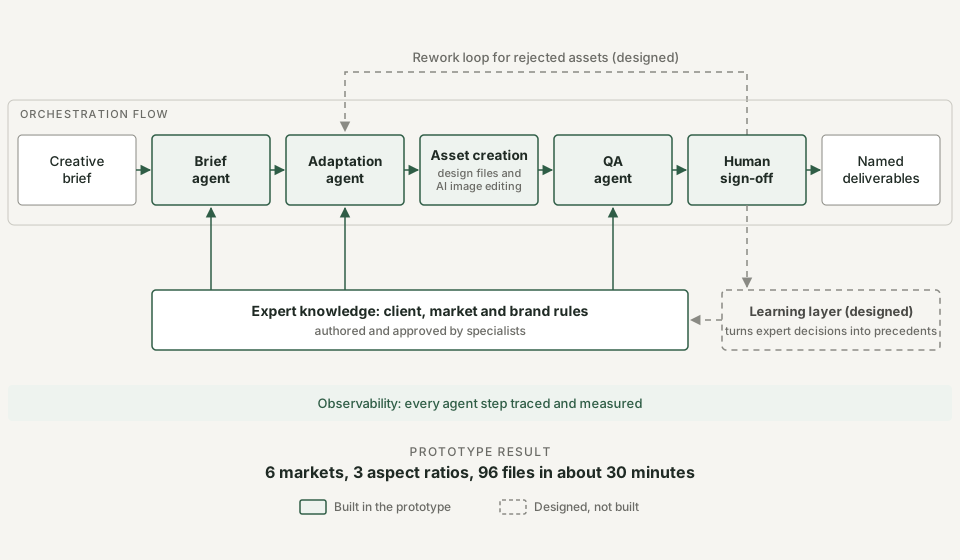
- Designed a multi-agent pipeline: a brief agent, an adaptation agent and a QA agent, with a human-in-the-loop step for reviewer sign-off.
- Specified an asset creation service that reads and writes layered design files and calls AI image editing directly, after trialling three image generation routes.
- Built the orchestration screens that run a job from brief to named, downloadable deliverables, with observability across every agent step.
- Designed the rework loop for rejected assets and a learning layer to capture expert decisions as reusable precedents.
The outcome
- A working prototype ran end to end: one social static from brief to final output across 6 markets and 3 aspect ratios, 96 files, in about 30 minutes.
- The rework loop and learning layer were fully designed but not built when development stopped.
- The business then chose to stay a premium managed service rather than become a software product, so the prototype was archived rather than taken into production.
What I learnt
- Test against the most demanding client's quality bar in the first weeks. A pipeline that is good enough for most work may still fall short of the client with the highest standards.
- Build one step fully integrated before starting the next. Building every component in parallel left the connections between them as the hardest and latest problem.
- The rework loop is core, not an add-on. Real work gets rejected and changed, so routing it back for correction belongs in the first version.
- Find latency early. Each agent step took two to three minutes. Building one step end to end first would have shown this while it was still cheap to address.
- Resource the ambition. A proof of concept that grows into a platform needs a platform team. That case has to be made early, and in a form that forces a decision.
What this shows
Productising a service starts by capturing the expertise it depends on, and proving the whole flow end to end. Knowing when a working product does not fit the business is as important as building it.